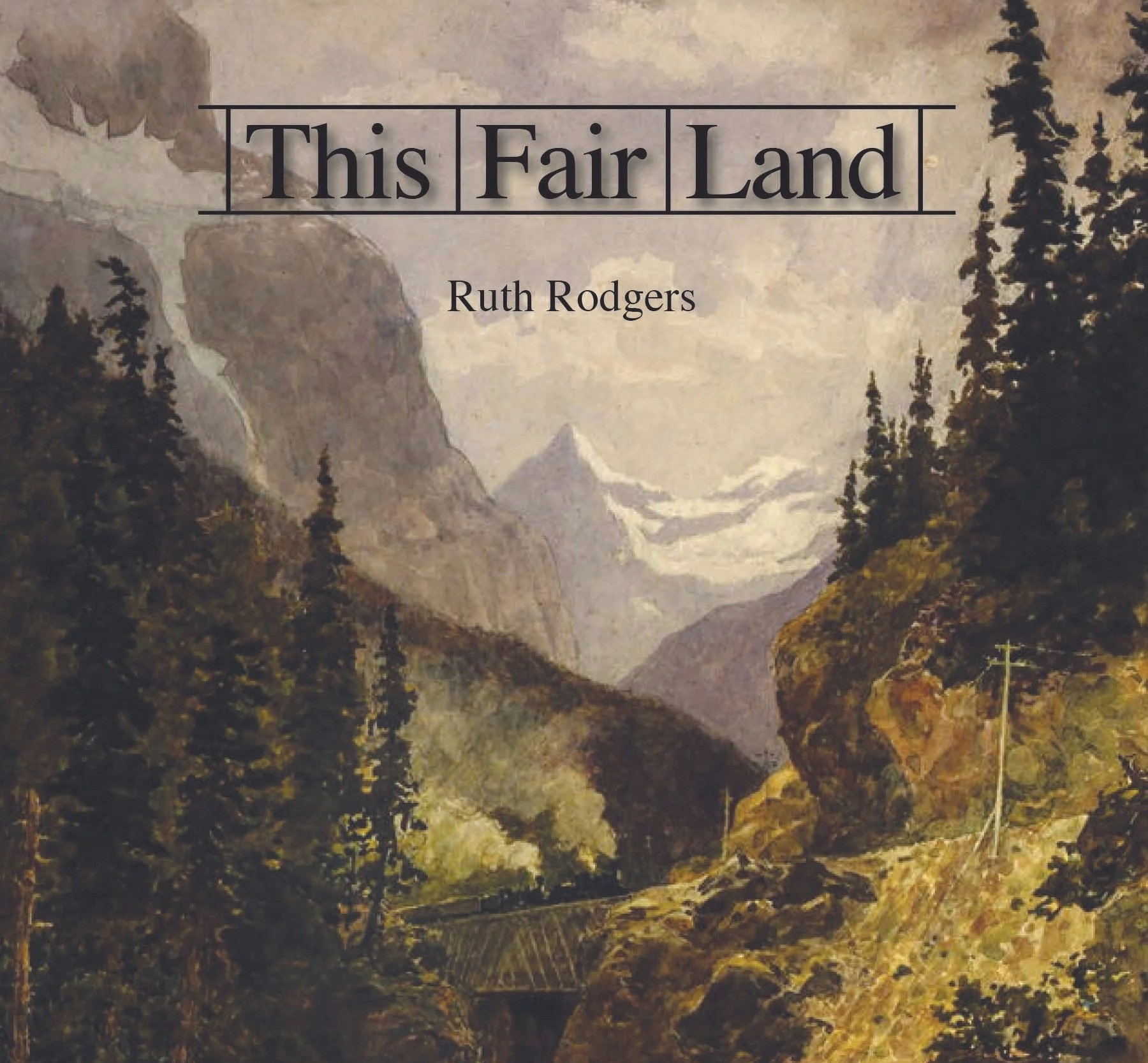
A story of the railroad
My fourth historical fiction novel explores the coming of the railroad to western Canada through the experience of a Black sleeping car porter who forms an unlikely friendship with a disguised Chinese laundry girl. The plot reveals the often-forgotten but deep prejudices against these cultural groups in Canada’s history and opens our eyes to both their challenges and their many contributions.
My books are available directly from me at my studio (contact me via email at rodgers.ruth@gmail.com), on Amazon (ebook available as well as print-on-demand), and at local bookstores here on the Sunshine Coast, BC: Talewind in Sechelt and EarthFair in Madeira Park.
“This is a GREAT BOOK! I sincerely enjoyed the journey back in time, an authentic story about the hidden truths of our Canadian history related to racism, complete with the correct terminology and dialect. She has inspired my heart by sharing a story of friendship and resilience in a time when hope was suffocated for those who were marginalized. It is evident that Ruth was committed to the authenticity of the story. A MUST read, if you want to learn about our history through the lens of our Afro-descendants and Chinese community members.” CG
"I thoroughly enjoyed it! You captured the fears, hopes, and dreams of disadvantaged peoples in Canada in a unique way. You also captured tragedy and despair, which is part of the lived experience. I think your perspective will be welcome particularly at this time when race is being tackled head on." JV
“I had trouble putting it down at times. Historical fiction is my favourite genre; needless to say, it really piqued my interest to read about the history of the CPR through the eyes of your characters. I liked how you showed the depth of the racial divides early on across Canada.” KY
“I would like to thank you for bringing awareness to what the Chinese and Black communities had to deal with during the 1880’s - 1920’s. As a young female Vietnamese/Chinese Canadian myself, I learned a lot about what happened in the past. As much as it pains me reading the story and knowing how accurate it was for a person of colour and especially a female having limited power, it has made me realize how extremely grateful I am that we have moved past most of these limitations, even though racism still continues today.” JC
“I enjoyed your first 2 books and I am now reading and enjoying your third. I am reading it slowly as I want to make it last and this slower pace has allowed me lots of time to contemplate the themes that you explore in the novel. Of course, I had long ago accepted that much of our history is quite shameful and in light of the current events, it seems to continue to be that way. The unmarked graves, the disproportionate use of violent force against any person of colour, and the resurgence of white privilege under the guise of freedom, all point to how much more work we need to do. Your book and the author’s notes have made me realize that it’s not enough to feel sad, rather being educated about our history and finding ways to change our society for the better are more appropriate ways to confront the hard truths.
Your writing just gets better and better and I hope I can look forward to reading another thought provoking novel written by you. Thanks for all of the hard work that went in to This Fair Land. (I loved the nod to Lightfoot’s song.)” KB
From a review in The Coast Reporter, July 15, 2021, by Rik Jespersen:
Ruth Rodgers’ third historical novel is a departure from her previous two, Those Who Wander, and Those Who Stay, both of which were set on the Sunshine Coast in the late 1800s and early 1900s. The new book, This Fair Land, is told in the same period but takes us to Vancouver, the B.C. Interior, and much of the way back east.
A Halfmoon Bay author, painter, and former teacher, Rodgers “explores a pivotal time in Canadian history, when the country was brought together for the first time by the transcontinental railroad and yet still deeply divided by racial prejudices and ingrained attitudes of class and entitlement,” as she wrote in a release announcing her July 6 online book launch.
The novel’s chapters alternate with the stories of Stanley, a Black porter on the Canadian Pacific Railway’s sleeper-cars, and Su Lin, the daughter of Chinese immigrants who, through her own wit and pluck, also wins a job working on the newly minted passenger trains.
As we are reminded to this day, most colonizers and settlers of this country treated the non-white inhabitants abominably, far into the 20th century. This Fair Land, which takes us to 1924 in freewheeling Montreal, tells of the Black and Chinese experiences through Stanley and Su Lin, who respond to their cruelly difficult and sometimes perilous circumstances with quiet outrage and, ultimately, winning determination.
“Canadian history fascinates me because even though I was raised and schooled in Canada, I have discovered that there are all kinds of stories about Canada that I knew nothing about,” Rodgers said at the book launch. “What keeps me interested in writing is ferreting out these sorts of hidden stories about Canadian history, that show us to be maybe a little bit different than we thought we were.”
Rodgers’ unearthed nuggets of our documented past are often not pretty, but weaving them into the narrative brings both the unvarnished reality and the fiction to life.