All Four Seasons in One Day

Like the variable spring weather we've been having, and the line from the Sting song, my students and I painted "all four seasons in one day" yesterday.  The lesson, designed to help us break free of over-reliance on photographs, required that we first do a value study from a photograph or a painting we'd already done, and then use a new seasonal palette to recreate the composition and value structure in a different colourway. One of students re-created a summer scene as a fresh and vibrant spring scene, and another made an even more dramatic shift from a summer scene to a snowy winter scene! By following the basic composition and value structure, but replacing the colours, a new painting was possible without a new reference.  When pursuing this exercise to its fullest and painting all four seasons, it's also interesting to vary the composition somewhat, by zooming in or cropping the original photo reference, or changing the format (from rectangular to square, for example) for a new painting.

Most importantly, moving away from the reference photo builds skills in terms of colour selection, value patterns, and drawing upon memory and observation of the natural world for your painting.  All of these make for more original, more creative work, which is often more "painterly" and interpretive than your first work from a photo might be.


I've mislaid the original photo, but my first painting (done several years ago) was this one, The Little Grove in Summer (9 x 12").  Below are three new interpretations of the same scene.


(Shower of Gold, 8.5 x 11")

(Winter Coat 8.5 x 11")

(Easter Grass 9 x 12")

Mini Me

In a recent conversation with my pastel students, I learned that one of them particularly loved a painting of mine that is in my own collection. Many artists keep a personal collection of works.  For me, these are the ones that fall into one or more of the following categories: 1) I painted it under the supervision of another artist in a course or workshop, and it is therefore ineligible to be shown in juried shows;

2) it represents a breakthrough in technique or approach for me, and I want to keep a memento of the lesson learned;

3) it is of a scene that has a significance to me (such as the small stream that crosses a corner of a road near my former house--when I reached that spot, I knew I was almost home);

4) I simply love it too much to part with it--or someone in my family does!

Buttercup Meadow (19" x 18.5"), pictured below, represents a breakthrough for me in the painting of various shades of green.  Recalling Richard McKinley's admonition that "purple is green's friend", I underpainted the whole scene in various values of purple, both blue purples and intense red-violets.  The resulting underpainting was pretty bright and a bit scary, but I gulped and started applying the many greens in this scene of spring by a meandering stream.  I was delighted to find that, indeed, the purples provided a great foundation for the various greens, giving them weight and variety. I allowed quite a bit of them to show through the scumbled greens, and in the forground grassy area, they gave the impression of textured foliage and perhaps tiny flowers--exactly the effect I was seeking. I was very pleased with the resulting painting, and when my husband (my best critic and fan) said it was the best work I'd done so far, I knew it was a keeper. Buttercup Meadow, obviously, fits into category 2 above, and it's unlikely I'll ever sell it.

When I heard that my student particularly liked this scene, however, I wondered if I could perhaps approach the scene again, but in a different format.  The result, Spring by the Stream (13" x 13") is the result. The new painting is much smaller than the original, has a slightly different composition, and includes brighter and more flowers in the meadow. However, I painted it in the same way (with a purple underpainting), and I think it is equally successful.  I'm not sure I'd make a habit of this--it's perhaps not a great idea to repeat myself and have many iterations of the same work--but in this instance, with an original work I don't intend to sell, and a person who really wanted one like it, I decided it would be ok to try it out. An interesting experience!

PastelBord--a new surface

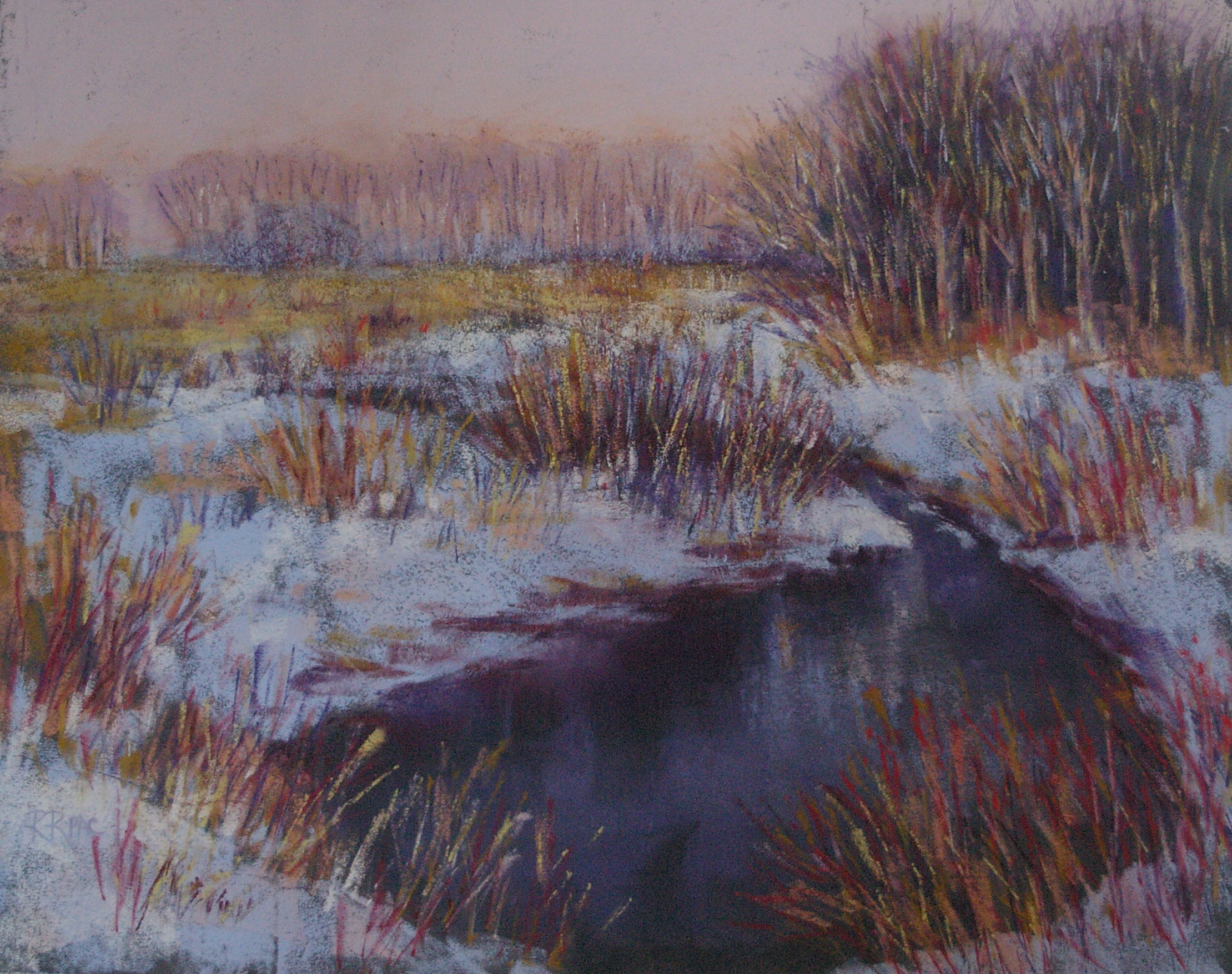
I've just tried out a new pastel painting surface--well, it's been around for awhile but I haven't tried it before.  It's called PastelBord and it's by Ampersand.  Each board is a rigid composition-board support coated with some kind of a clay mixture.  It doesn't feel as if it has a lot of tooth--it's sort of like suede--but the label insists that it accepts "unlimited layers" so I thought I'd give it a try. Inspired by the emerging signs of spring here, I chose a scene featuring the burgeoning colours in the willows and dogwoods along local streams. The first lesson I learned was to make sure that whatever I draw on it with isn't too sharp.  I laid out my composition with a pastel pencil that had been carelessly sharpened (by me!) and which had a protruding sharp point of wood.  This point scratched into the clay surface, and created shallow grooves that were nevertheless somewhat hard to disguise with later applications of pastel.  Note to self: sharpen your pencils more carefully or use a pastel stick for layout!

After that epiphany, however, all went smoothly.  The surface is easy to blend and layer on, and the gray colour (it also comes in white) really made the pastel hues jump out.  It's a bit more expensive than sanded paper, but the advantage is that your framer won't have to add a rigid backing board to it when framing, so it works out about the same in the end.

I like this product, and have special-ordered eight of their largest size (I think it's 24 x 30) for special works that are planned for an exhibition in 2013 at Station Gallery in Whitby, Ontario.  What will they be?  I don't know yet, but I'm sure having these large boards around will inspire me! :)

Here's the piece that resulted, titled Early Colours.


A Portrait Experience

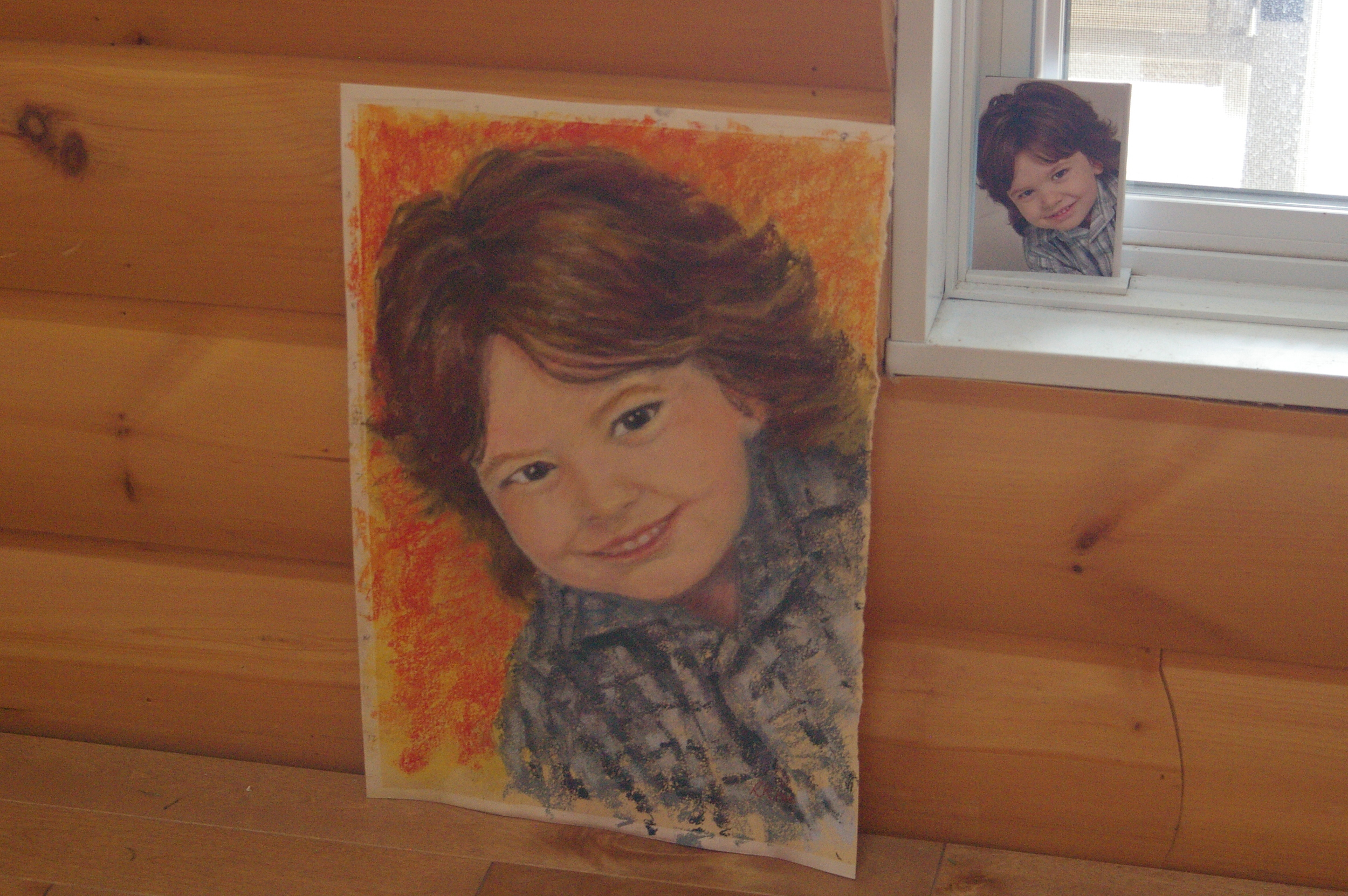
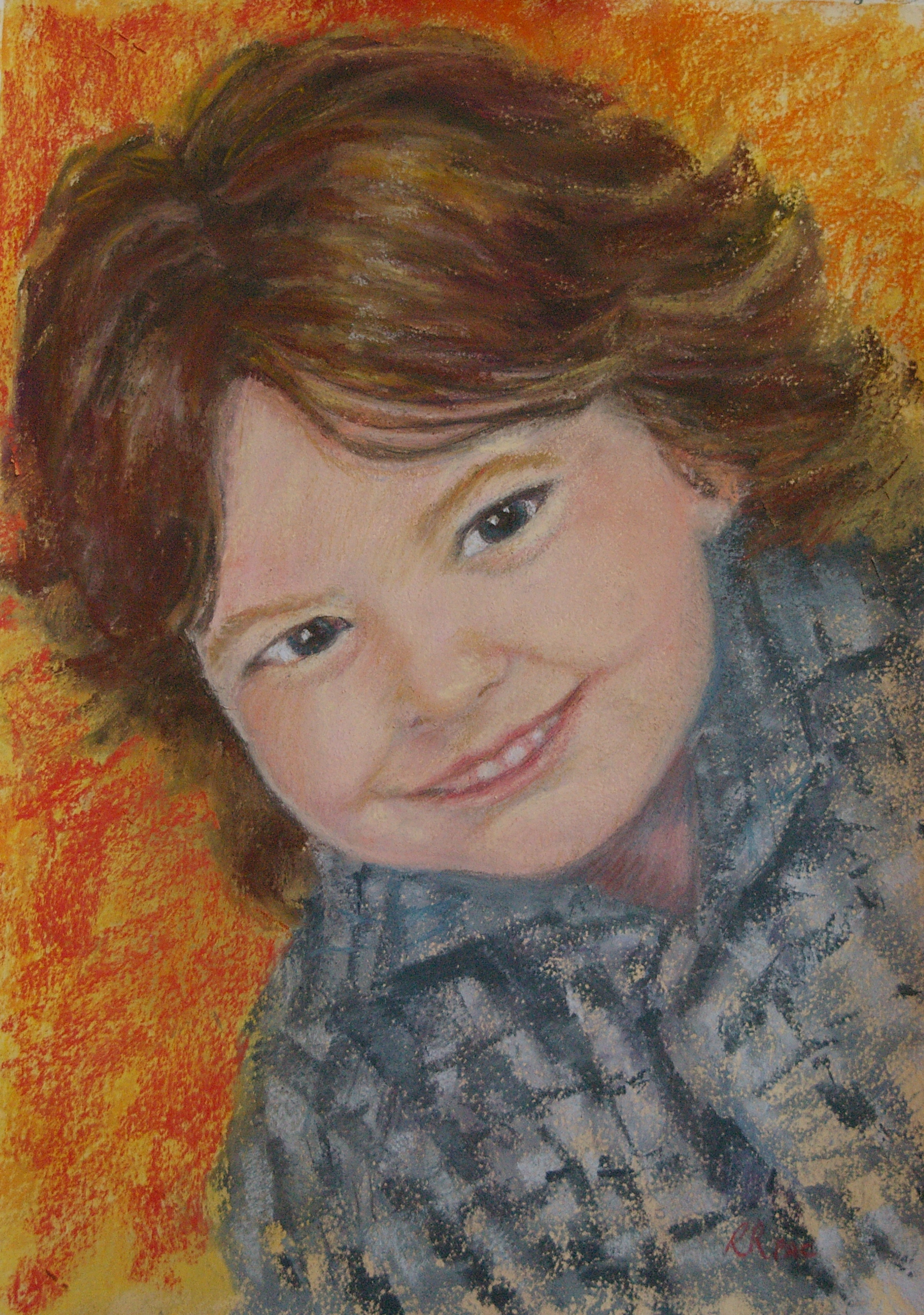
When my friend and colleague asked me to paint a pastel portrait of her three-year-old son, I was both delighted and a bit nervous.  Painting a portrait of someone specific is a lot different from painting "a person." I feel confident that I can do a credible job of rendering the human face and body, but the challenge of capturing the spirit and personality of a particular child was a new goal.  Could I achieve it? My friend sent me a number of charming pictures of her son, and we agreed on one that featured a diagonal composition, with his head tilted and his eyes impishly meeting those of the viewer. In an approach unusual for me, I carefully enlarged the photo to a black and white photocopy, then gridded it out in 1" squares.  Having selected a warm but pale ochre Colorfix paper to work on, I drew a 1.5" grid and scaled up the main features.  On a portrait, the alignment and spacing of each feature is critical, and if it isn't right the likeness is lost.  I didn't want the final painting to be what John Singer Sargent once said a portrait was: "a painting of a person in which something is wrong with the mouth"!

Happily, the portrait progressed well and gave me less angst than I expected.  To bring warmth to the piece, in which the child is wearing a cool blue plaid shirt, I chose complementary orange and warm yellow tones for the background, which, coincidentally, turned out to be the colours in the room where the portrait will hang.  Phew!

We had agreed that I would send the portrait across Canada to my friend, unframed, and she would frame it to her taste.  Worried that the pastel would be creased or punctured, I sandwiched it between two sheets of 1/4" fome-cor, with an extra piece of stiff mat added to keep it rigid and a sheet of glassine to keep it from smudging.  I slathered "fragile artwork--do not bend or puncture" warnings all over both sides, and sealed the edges of the package with sturdy duct tape. Choosing express post to minimize the time it would spend in transit, I also insured the package for the value of the unframed painting, and sent it off with a silent prayer for its safe delivery.

Miraculously, the package arrived safely within 24 hours, and my friend reported delightedly that her son recognized himself immediately.  His mother was very gracious in her praise, and it seems we have a happy result.  Thank goodness!  This process was less nerve-wracking than I had feared, and encourages me to take on other commissions in future.

Dancing with Degas

It's an unbreakable rule in art circles that you work only from your own reference photos, and for work that will be shown in competition or sold, I adhere strictly to that rule.  However, when I saw the photograph that prompted this painting, in an old magazine ad for the ballet in New Zealand, I just couldn't resist, The composition, with its deep space and cut-off figure at the right, was very reminiscent of Degas' ballet and cabaret paintings.  Photography was a young science in Degas' time, and he, like many other artists of the day, was fascinated by its ability to capture a "snapshot" of real life as opposed to posed, stiff tableaux, resulting in many compositions with partial figures along the edges. As well, the artificial light of the stage, bathing the principal dancer in a dramatic glare from the footlights, also reminded me of the many paintings in which Degas used heavily textured layers of brightly coloured pastel to recreate the unnatural brightness and temperature of stage lighting.

I did change the principal dancer from the male in the photo to a female, wanting to introduce a hint of a storyline (is the lefthand dancer jealous of the principal dancer?  Is her hands-on-hips gesture one of pique or simply readiness for her entrance?), and also enjoying creating her tulle skirt, uplit by the footlights. I also simplified the surroundings quite a bit, eliminating distracting props and scenery fragments.

So, this one was just for the pleasure of doing it--but I am framing it for my six year old granddaughter's birthday! I called it "In the Wings" and am indebted to the unknown photographer for the inspiration.